The Loom, the Computer, and the Workers
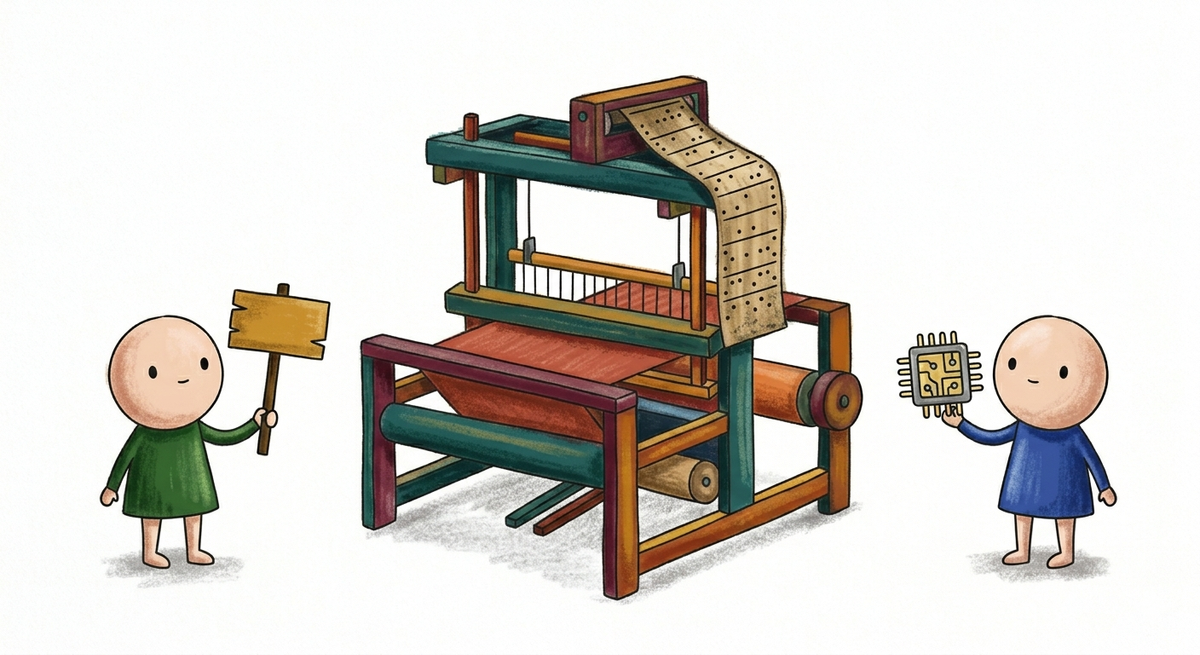
Happy International Workers' Day! Did you know that labor unions and computers are unlikely cousins, with a common ancestor in the loom.
Across 1801-1804, Joseph Marie Jacquard invented the eponymous Jacquard Loom. It used punch cards to control intricate weaving patterns. This made weaving far less labor-intensive, and over just a few years, wages for weavers fell massively. In 1811, Luddites (named for a mythical figure famed for breaking a loom) began rioting and destroying the automated looms. Importantly, the rioters did not object to technology on its face; they objected to being discarded from their profession with no social safety net available. The British government responded by instituting the death penalty for their crimes with the "Breaking Frames" act. Thus, destroying the equipment used to displace them became doubly a capital crime.
While there is not a direct organizational lineage from the Luddites to the organized labor movement of the 20th century, the latter is the clear successor of the former. Collective bargaining replaced destruction of capital, but the essential process of collective action to protect laborers against economic abuse was the same — as was the violent response of the ruling class.
On the other branch of the tree, Charles Babbage and Ada Lovelace were inspired by the Jacquard Loom's punch card system in designing the Analytical Engine in 1837. Herman Hollerith would go on to implement a punch card-based electromechanical tabulating machine for the 1890 US Census, and in the coming decades computers like ENIAC would use punch cards for binary input and output not too different from the opcodes that our processors use internally even today.
As technologists, let us remember our cousins as disruptive technologies burst onto the scene at an unprecedented rate. Inside a responsible and effective adopter of AI beats the heart of a Luddite: not an opponent of technology, but a proponent of those who deserve to benefit from it.
